Data Structure
Data Structure
1. Abstract Data Type (ADT)
1 | {% pdf /pdf/考IELTS时更像NativeSpeaker.pdf %} |
1.1. Data type
A set of objects + a set of operations
Example: integer
—- set of whole numbers
—- operations: +,-,*,/
1.2. Abstract data type
- High-level abstractions (managing complexity through abstraction)
- Encapsulation(封装)
1.3. Encapsulation(封装)
- Operation on the ADT can only be done by calling the appropriate function.
- No mention of how the set of operations is implemented.
(没有提到操作集是如何实现的)
The definition of the type and all operations on that type can be localized to one section of the program.
If we wish to change the implementation of an ADT
—-We know where to look.
—-By revising one small section we can be sure that there is no subtlety elsewhere that will cause errors.
We can treat the ADT as a primitive type(基本类型): we have no concern with the underlying implementation.
- ADT——>C++: Class
- Method——>C++:Member Function
1.4. ADT
- Example
- The set ADT
- A set of elements
- Operations: union, intersection, size and complement.
- The queue ADT
- A set of sequences of elements
- Operations: create empty queue, insert, examine, delete, and destroy queue.
- The set ADT
- Two ADT’s are different if they have the same underlying model but different operations
- E.g. a different set ADT with only the union and find operations
- The appropriateness of an implementation depends very much on the operations to be performed.
1.5. Pros and Con
- Implementation of the ADT is separate from its use.
- Modular: one module for one ADT
—- Easier to debug
—- Easier for several people to work simultaneously.
Code for the ADT can be reused in different applications.
Information hiding
—-A logical unit to do a specific job.
—-Implementation details can be changed without affecting user programs.
- Allow rapid prototyping
—- Prototype with simple ADT implementations, then tune them later when necessary.
- Loss of efficiency
2. Linked List ADT
2.1. The element in the “List ADT”
- The elements in the list: A1,A2,…An
- N: the length of the list
- A1: the first element.
- An: the nth element.
- If N =0, the the list is empty.
Linearly ordered.
</div>
2.2. Operations
makeEmpty: Create an empty list.(Actually it is not in the implement.)
insert: insert an object to a list.
—-Example:
insert(x,3)-> 34,12,52,x,16,12
(insert x in the position “3”)
remove: delete an element from the list.
—-Example:
remove(52)->34,12,x,16,12
(The element “52” is moved out the list.)
find: locate the position of an object in a list.
—-Example:
list: 34,12,52,16,12;
find(52)->3;
printList: print the list.
2.3. There are two standard implementations for the list ADT:
2.3.1. Array Implementation
Elements are stored in contiguous array positions.

Requires an estimate of the maximum size of the list. (waste space)
Two extremely case:
1. e.g. insert at position “0” (making a new element)require first pushing the entire array down one spot to make room
(如果是在位置“0”插入一个值,那么后面的每一个值都要向后挪移一位,这样的算法比较繁琐。)
2. e.g. delete at position “0”
require shifting all the elements in the list up one
(遇上一种情况相似,但是每一位向上移动一位)
On average, half of the lists needs to be moved for either operation
2.3.2. Pointer Implementation(==Linked List==)

Ensure that the list is not stored contiguously(连续地)(与array list的区别).
-use a linked list.
-A series of structures that are not necessarily adjacent in memory.
Each node contains the element and a pointer to a structure containing its successor.
-The ==last== cell’s next link points to ==NULL==.
Compared to the array implementation:
The pointer implementation uses only as much as space as is needed for the elements currently o the list.
But requires space for the pointers in each cell.
2.3.2.1 Linked list
1. A ==Linked List== is a series of connected ==nodes==.
2. Each node contains at least:
3. ==Head==: Pointer to the first node.
4. The last node points to ==NULL==.

2.3.2.2 The code of Linked List
1. LinkedList.h
1 | /* |
2. LinkedList.cpp
1 | //LinkedList.cpp |
3. main.cpp
1 | //main.cpp to test the LinkedList |
2.3.2.3 The analysis of the code
1. The operation of append():
1 | void LinkedList::append(int number) { |
First of all, we should check whether the “==head==” points anywhere, if not, then the “Liked List“ is an empty list. Then we create a “newNode“ to store the new element, since the list is empty, we let the “==head==” equal to the new node and by the function “setNext()” set the head next is empty, which is helpful for the latter append.
Secondly, since the list is not empty , our function move to the “else” part. There are many ways to do the “else” part, here I choose the way that create two node:”prevNode”, “currNode”. In the “while” loop, the condition that run out of the loop is check whether the “currNode” is empty or not. In the “while” loop, after every looping, we will update the “currNode”, then the “currNode” will point to its next position, so for the out-loop condition, when the “currNode” is NULL, the “while” loop will stop. But if there only have “currNode” then the later function will not easily implement what we want to do(because the “currNode” points to NULL), so that we need “prevNode” to store the “last” node in the list. So after the “while” loop, our “currNode” comes to the NULL, but the “prevNode” comes to the last node, which is point to the NULL(“currNode”). And then we can do append operation to let the “prevNode” point to the new element, and the new element points to the “currNode”——the NULL.
2. The operation of insert():
1 | bool LinkedList::insert(int pos, int num) { |
First, the “listSize” stores the size of the list, the size of the list is “listSize” -1, and the “listSize” will be updated in the first while loop.
Then the “if” function is to check whether the “pos” delivery into the insert() function is in in the range of the listSize. If not return false.
After check the whether the pos is available, the code goto the else part. It is the same idea of append().
3. The operation of getSize():
1 | int LinkedList::getSize() { |
This code is a very simple function to return the size of the Linked List, it has the same principle with the first part of the insert( ) function.
4. The operation of remove() :
1 | bool LinkedList::remove(int pos) { |
The ability of this function is remove the element in the given position in the list.
First, the “if” equation is to check whether the pasted position is possible or not.
Move to the “else” part, the conditions of break the while loop are: 1. Whether the currNode is NULL or not ==and== whether the pasted position is out of the range of the Linked List or not.
After the while loop break, there is going to check what the condition make the it stop. So in the “if condition” we are going to check whether the currNode is NULL or not, if it is “null”,that proves the position is out of range, then it will return “false”. Oppositely, it will go to the “if”. For the “if” condition: if(prevNode), it is check the position is “1” or not, if it is “1”, then the while loop will not work, and the prevNode is NULL. Remove operation is easy to understand, let the prevNode points to the next node of currNode, and delete the currNode.
5. The display function
The display function is easy to understand, so I will not analysis here.
3. Stacks and Queues
3.1 Stacks
3.1.1 Stacks ADT
- A ==stack== is a ==list== in which insertion and deletion take place at the same end

- The end of “2” is called ==”top“==.
- The other end is called ==”bottom“==.
Stacks are know as ==”LIFO“== (Last in, First out) lists.
- The last element inserted will be the first to be retrieved.
3.1.2 Push and Pop
- Primary operations: ==Push== and ==Pop==.
-Push:
Add an element to the top of the stack.
-Pop:
Remove the element at the top of the stack.

3.1.3 Implementation of Stacks
1. Based on array
1 | /* |
1 | /* |
2. Based on Linked list
- Now let’s implement a stack based on a linked list.
- To make the best out of the code of List, we implement Stack by inheriting List.
- To let Stack access private member head, we make Stack as a friend of List.
1 | class List { |
1 | class Stack : public List { |


3.2 Queue
3.2.1 Queue ADT
Like a stack, a queue is also a list. However, with a queue, insertion is done at one end, while deletion is performed at the other end .
Accessing the elements of queues follows a ==First In, First Out (FIFO)== order.
- Like customers standing in a check-out line in a store, the first customer in is the first customer served.

3.2.2 Enqueue and Dequeue
Primary queue operations: Enqueue and Dequeue
Like check-out lines in a store, a queue has a ==front and a rear==.
Enqueue – insert an element at the rear of the queue.
Dequeue – remove an element from the front of the queue

3.2.3 Implement
1. Based on array
1 | /* |
1 | /* |
2. Based on Linked list
1 | class Queue { |
1 | void Queue::Enqueue(double x) { |
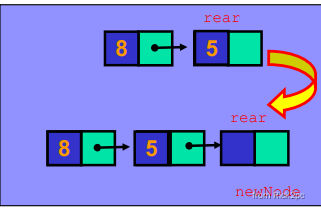
1 | bool Queue::Dequeue(double & x) { |

1 | void Queue::DisplayQueue() { |
4. Analysis of Algorithms
4.1. Introduction
What is Algorithm?
A clearly specified ==set of simple instructions== to be followed to solved a problem
- Takes a set of vales, as input.
- produces a value, or set of values, as output.
May be specified
In English.
As a computer program.
As a pseudo-code(伪代码).
- Data structures
- Methods of organizing data.
- Program = algorithms + data structures
4.2. Algorithm Analysis
We only analyze correct algorithm.
An algorithm is correct.
- If, for every input instance, it halts with the correct output.
Incorrect algorithms
Might not halt at all on some input instances.
Might halt with other than the desired answer.
Analyzing an algorithm
- ==Predicting== the resources that the algorithm requires.
- Resources include
- Memory
- Communication bandwidth
- Computational time(usually most important)
Factors affecting the running time
computer
compiler(编译器)
algorithm used
input to the algorithm
The content of the input affects the running time.
Typically, the ==input size== (number of items in the input) is the main consideration.
-E.g. sorting problem
the number of items to be sorted. -E.g. multiply two matrices together
the total number of elements in the two matrices.
Machine model assumed
- Instructions are executed one after another, with no concurrent operations
Not parallel computers.
- Instructions are executed one after another, with no concurrent operations
4.3. Time Complexity
Worst case running time
The longest running time for any ==input of size n==.(问题的规模)
An upper bound on the running time for any input
guarantee that the algorithm will never take longer.(You can think like the Big-Oh notation) Example: Sort a set of numbers in increasing order; and the data is in decreasing order.
==The worst case can occur fairly often.==
- Best case of an running time
- Example: Sort a set of numbers in increasing order; and the data is already in increasing order.
- Average case running time
- Difficult to define.
4.3.1 Big-Oh Notation

Definition
if there are positive constant c and such that when . (Never mind the N and the n in the formula. They all represent the size of the problem.)
(
的增长率小于或等于 的增长率。for large N) (
,表示随问题规模N的增大,算法执行时间的增长率和 的增长率相同) (实际上我看相关的教材上一般会习惯把这里面的
可能是更好地表达时间复杂度的意思。) The growth rate of
is less than or equal to the growth rate of . ==
== Example:
Let
Then the probable answer is: (
)
There are also many other answer, but the third answer in here is the best answer.
Some rules
When considering the growth rate of a function using Big-Oh, ignore the lower order terms and the coefficients of the highest-order term.
- Like:
then .
- Like:
No need to specify the base of logarithm.
(不需要指定对数的底数。)
Changing the base from one constant to another changes the value of the logarithm by only a constant factor.
Like:
.
If
and , then: - $T_1(N)T_2(N)=O(f(N)g(N))$
4.3.2 Big-Omega Notation

Definition
if there are positive constant c and such that when . grows no slower than for “large” N - The growth rate of
is greater than or equal to the growth rate of .
4.3.3 Big-Theta Notation

- Definition
if and only if and . - The growth rate of
equals the growth rate of . - Big-Theta means the bound is the tightest possible.
- Example:
- Example:
- Rules:
- If
is a polynomial of degree k, then
- If
- For logarithmic functions,
- For logarithmic functions,
4.3.4 General Rules
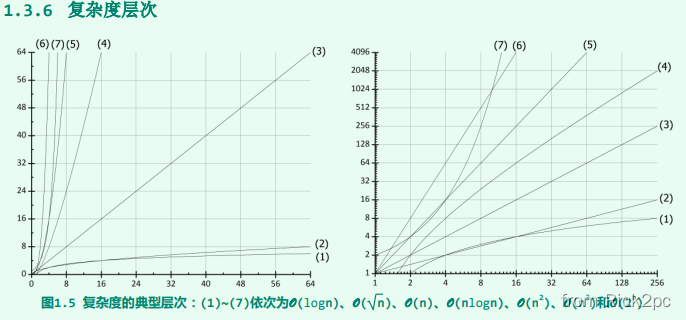
==Using L’Hopital’s Rule==
- ==Determine the relative growth rates (using L’Hopital’s rule if necessary)==
- Compute
- if 0:
and is not ( ). - if constant , but not equal to 0:
. - if
: ( ). - limit oscillates: no relation.
- ==Determine the relative growth rates (using L’Hopital’s rule if necessary)==
Stirling’s approximation
-
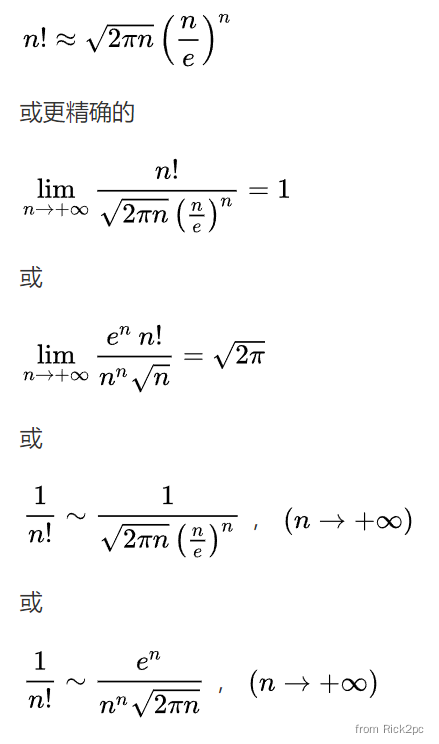
Example:
;
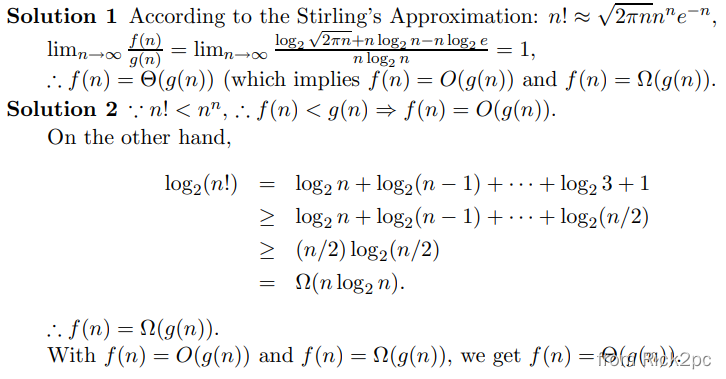
Running time calculation
Rule 1- For loop:
- The running time of a for loop is at most the running time of the statements inside the for loop (including tests) times the number of iterations.
Rule 2—Nested loops(嵌套循环)
- Analyze these inside out. The total running time of a statement inside a group of nested loops is the running time of the statement multiplied by the product of the sizes of all the loops.
1
2
3for( i = 0; i < n; ++i )
for( j = 0; j < n; ++j )
++k;
Rule 3—Consecutive Statements
$T_1(N)T_2(N)=O(f(N)g(N))$
1
2
3
4
5for( i = 0; i < n; ++i )
a[ i ] = 0;
for( i = 0; i < n; ++i )
for( j = 0; j < n; ++j )
a[ i ] += a[ j ] + i + j;
Rule 4—If/Else
- The running time of an if/else statement is never more than the running time of the test plus the larger of the running times of
and .
- The running time of an if/else statement is never more than the running time of the test plus the larger of the running times of
Other rules are obvious, but a basic strategy of analyzing from the inside (or deepest part) out works. If there are function calls, these must be analyzed first. If there are recursive functions, there are several options. If the recursion is really just a thinly veiled for loop, the analysis is usually trivial. For instance, the following function is really just a simple loop and is O(N):
1 | long factorial( int n ) |
This example is really a poor use of recursion. When recursion is properly used, it is difficult to convert the recursion into a simple loop structure. In this case, the analysis will involve a recurrence relation that needs to be solved. To see what might happen, consider the following program, which turns out to be a terrible use of recursion:
1 | long fib( int n ) |
At first glance, this seems like a very clever use of recursion. However, if the program is coded up and run for values of N around 40, it becomes apparent that this program is terribly inefficient. The analysis is fairly simple. Let T(N) be the running time for the function call fib(n). If
Since
4.4 Cases study: The Maximum Subsequence Sum Problem.
4.4.1 The maximum subsequence sum problem
- Given(possible negative) integers
find the maximum value of . - For convenience, the maximum subsequence sum is 0 if all the integers are negative.
4.4.2 Algorithms of the cases and analysis
Case 1: Brute Force(暴力穷举)
1.1 Code
1 | int MaxSubSeqSum_BruteForce(int* arr, int size, int& max_start, int& max_end) { |
1.2 Algorithm analysis
The Time Complexity
The most important part of the code if the third for loop if we can calculate the time of it spend, than we can get the time complexity of the whole function.
So there may be a roughly sum of the time that the code go through:==
==, where N represent the size of the problem. -First :
-Second:
-Third:
Then the final result is the third result, then the time complexity: ==
==; Code Explain:
这里我们用中文解释一下代码的原理:
首先声明:对于暴力穷举算法, 它的时间复杂度为
根据我们的认识,这样大的指数级别的时间复杂度是极不利于我们面对大量级的数据时调用该函数解决问题。

Case 2: Divide and Conquer (分而治之)
2.1 What is “Divide and Conquer” ?
- Split the problem into two roughly equal subproblems, which are then solved ==recursively==.
- Patch together the two solutions of the subproblems to arrive at a solution for the whole problem.
- The maximum subsequence sum can be:
- Entirely in the left half of the input.
- Entirely in the right half of the input.
- It crosses the middle and is in both halves.
2.2 A case of the “Divide and Conquer” to help you know about it.

2.3 Code
1 | int Max_Divden(int* arr, int s, int e, int& start1, int& end1) { |
2.4 Algorithm analysis
如果你能看懂2.2那你应该能看出来分而治之的真实含义,其实每一次执行一次迭代都是从原来的序列的中间部分展开来分成了两个子序列再继续执行。所以对于一个规模为N的一个序列,我们用分而治之的方法就相当于将它拆成了两个子问题,然后两个子问题自己又会分别拆成两个子问题直到最后分到只剩下一个元素,然后将相关的值返回。
所以问题规模为N的问题的时间复杂度为
里面的“
最后我们将
最后
5. Sort
5.1 Bubble Sort()
1. Code
1 | void Sorting::BubbleSort(int* NumList){ |
2. The process

According to the code and the picture, you may understand the process of the “Bubble sort”. First of all, from the picture we can easily know that the whole function will at least do through n times then it may be sorted. So that, for the first for loop it may go n times. And in the second for loop, it will go to N-1 times to compare the num[j] and num[j+1] (前一个和后一个两两比较), then if the former is larger than the latter, the swap them. So that from the picture you can know that every time, the “largest” in the surplus sequence will be put the suitable position(其实就是说剩余序列里面最大那个数据最终会排在剩下的序列里面的最后的位置,最后,整个序列就会以一个升序的序列排好。).
1>比较相邻的元素。如果第一个比第二个大,就交换他们两个。
2>每趟从第一对相邻元素开始,对每一对相邻元素作同样的工作,直到最后一对。
3>针对所有的元素重复以上的步骤,除了已排序过的元素(每趟排序后的最后一个元素),直到没有任何一对数字需要比较。
3. Time complexity
冒泡排序的时间复杂度:每一次外部循环中内部循环次数的和。
It is the worst case. But actually, there is a improved code of the Bubble sort, which time complexity is
1 | void bubbleSort(int array[], int length) |
5.2 Insertion Sort()
1. Code
1 | void Sorting::InsertSort(int* NumList){ |
2. Process
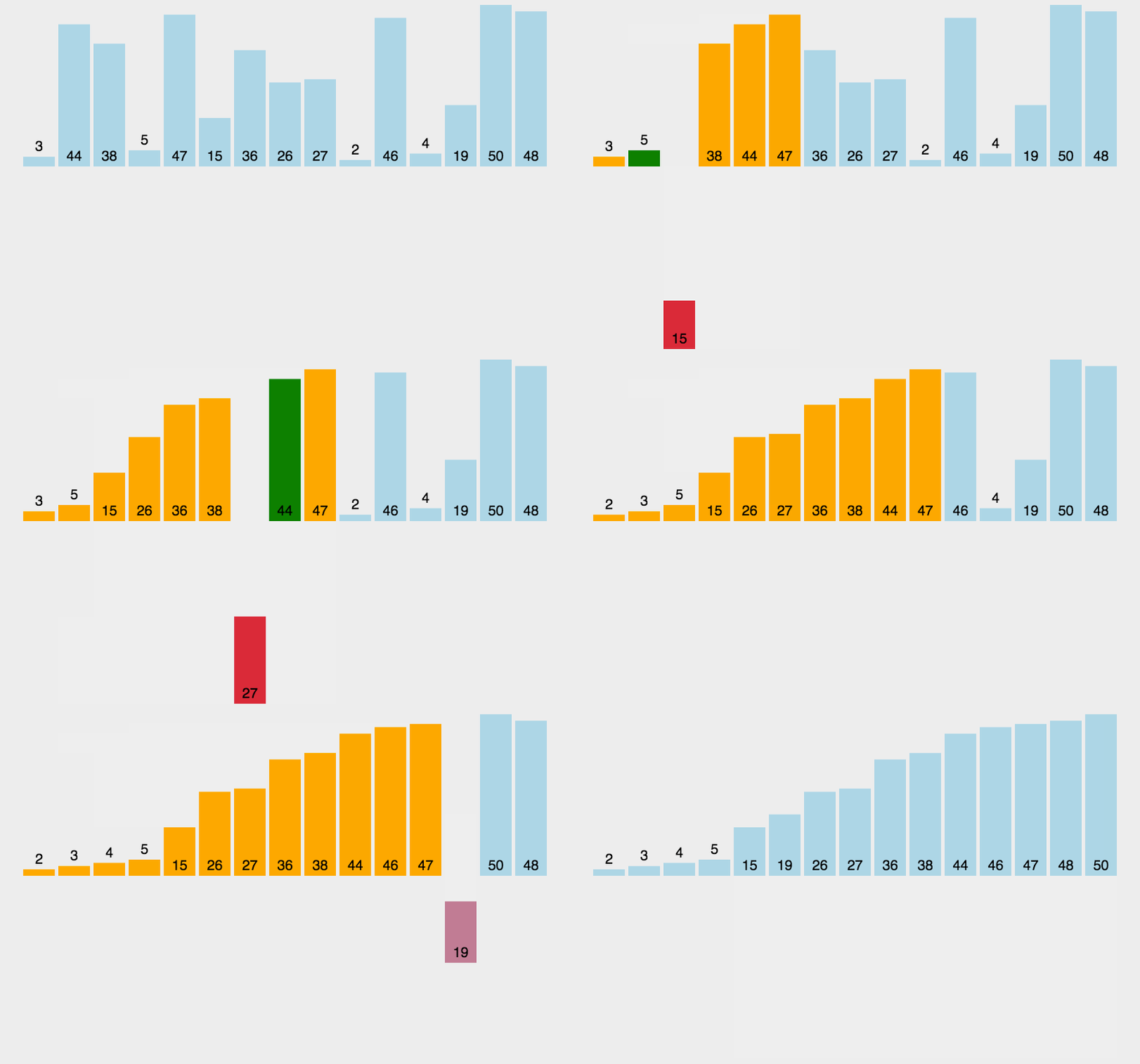
插入排序的思想是: 将初始数据分为有序部分和无序部分,每一步将一个无序部分的数据插入到前面已经排好序的部分中,直到插完所有元素为止。
每次从无序部分中取出一个元素,与有序部分中的元素从后向前依次进行比较,并找到合适的位置,将该元素插到有序组当中。可以看看图例。
3. Time complexity
The worst case : 最坏的情况跟冒泡排序差不多: Inner loop is executed p times, fr each p= 1,2,…,N-1;
再加上外层循环:
The best case:
- The input is already sorted in increasing order
When insertinginto the sorted , only need to compare with and there is no data movement. - For each iteration of the outer for-loop, the inner for loop terminates after checking the loop condition once $\geq O(N)$ time. - If input is ==nearly sorted==, insertion sort runs fast.
5.3 Merge Sort()
1. Code
1 | /*Merge two sorted array. Used in MergeSort*/ |
2. Process

3. Time complexity
Actually in my perspective, you can treat this like the “Divide and Conquer” .
1 | void Sorting::MergeSort(int* NumList, int start, int end) { |
In the “MergeSort()” we can see that it is very similar to the “Divide and Conquer”, in the code we can see that:
For the line 1, actually every time the if will run, but only when the condition in it is true the “return” will run. And when the condition is true, which is 
And for the line 2——the divide step, it’s
For the “Conquer step”: After we divide the original array, then the sub array should continue divide until catch the “if” condition. And to complete this part, we should do the divide step two times, just the operation of line 3 and line 4. And since we divide the original from the midpoint, the line 3&4 will spend the same time which equal to
Finally for the “Combine step”, here I will show the pseudo-code of the “Merge()” function:

与前面的分而治之类似,我们在这里要比较左右两个subsequence的相同位置的element后,根据比较的结果修正原sequence的element的位置,所以我们肯定要遍历到每一个element,所以时间复杂度为
So that
5.4 Quick Sort()
1. Introduction
==Fastest== known sorting algorithm in practice;
Average case:
; Worst case:
; - But, the worst case seldom happens.
Another divide-and-conquer recursive algorithm, like merge-sort.

2. Code
1 | void Swap(int* NumList, int i, int j){ |
3. Idea
3.1 Partitioning
- This is a ==key step== of the quick sort algorithm.
- ==Goal==: given the picked pivot, partition the remaining elements into two smaller sets.
- Many ways to implement how to partition:
- Even the slightest deviations may cause surprisingly bad results.
3.2 Partitioning Strategy

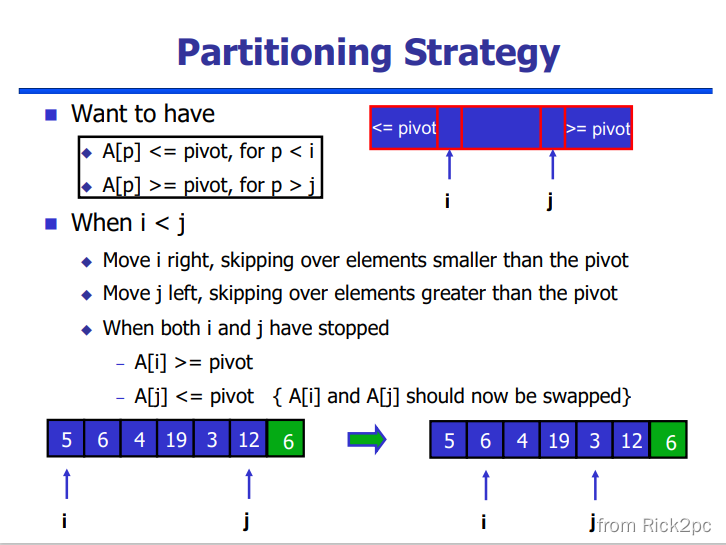

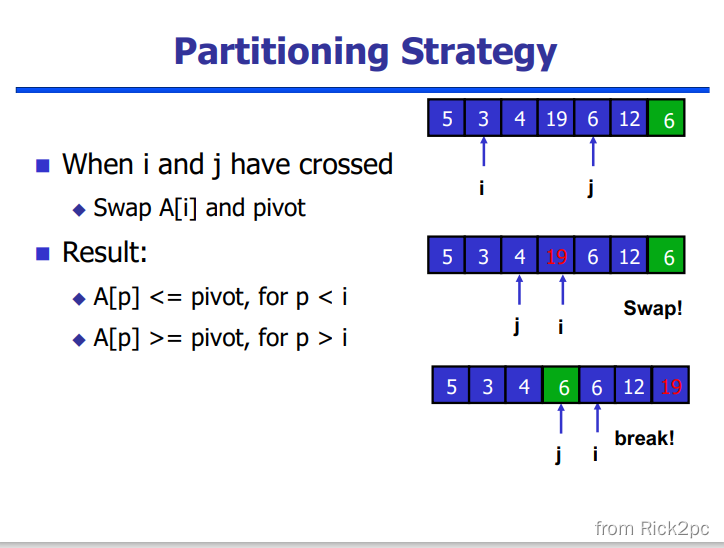
3.3 Picking the Pivot
Use the first element as pivot
- if the input is random, OK
- if the input is presorted (or in reverse order)
- all the elements go into
(or ) - this happens consistently throughout the recursive calls.
- Results in
behavior (Analyze this case later)
- all the elements go into
Choose the pivot randomly.
- Generally safe.
- Random number generation can be expensive.
Use the median of the array
- Partitioning always cuts the array into roughly half.
- An ==optimal== quick sort (
) . - However, hard to find the exact median
- Sort an array to pick the value in the middle.
Median of three


Why we only do the partition

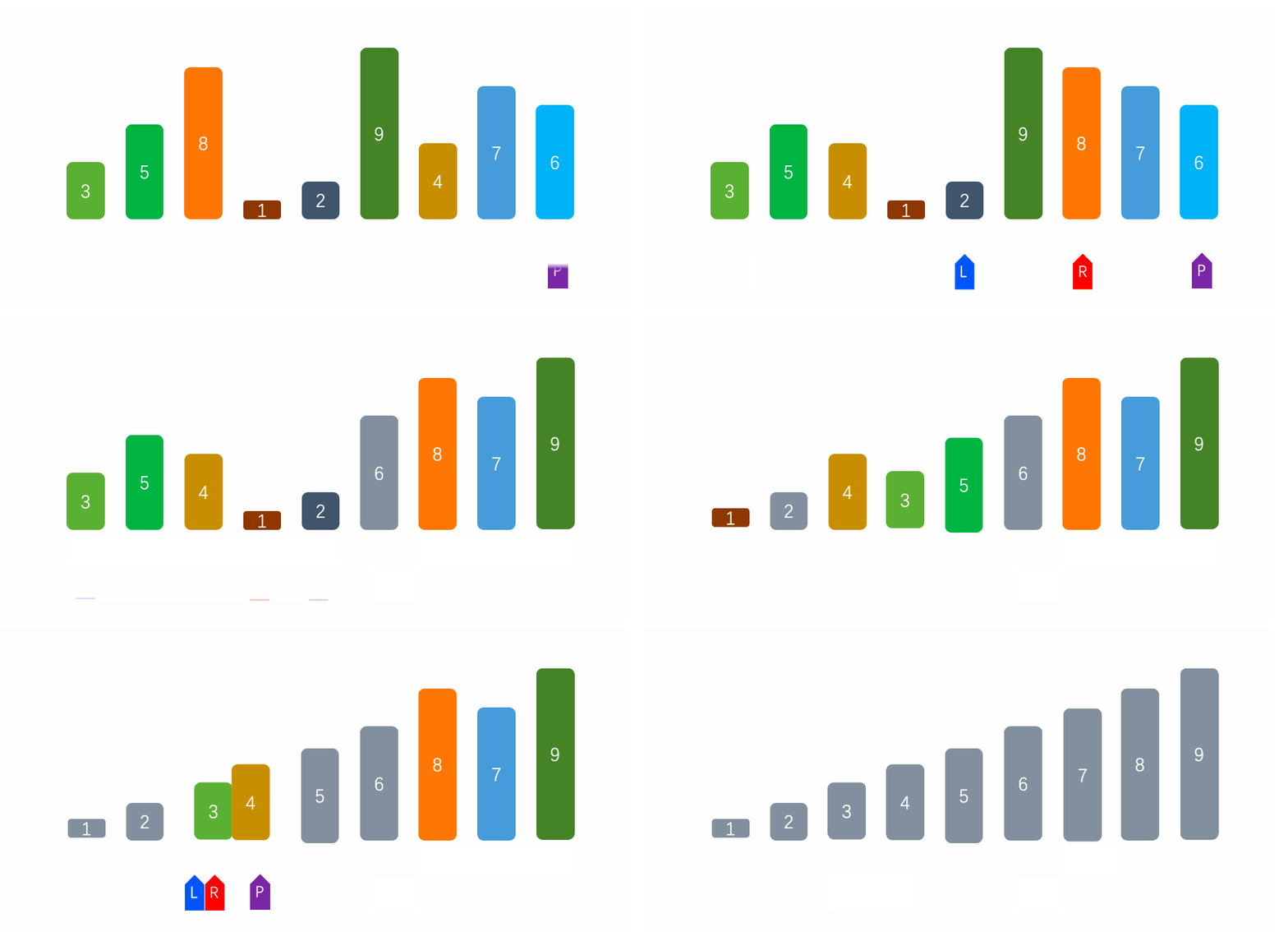
4. Time complexity
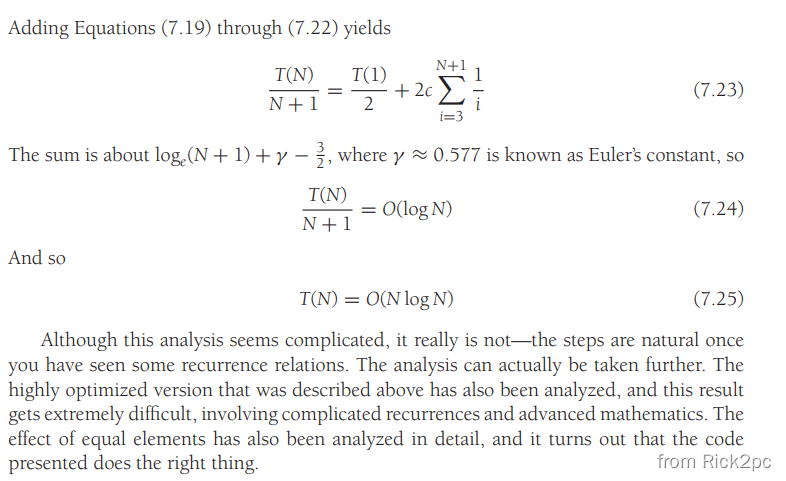
Like mergesort, quicksort is recursive; therefore, its analysis requires solving a recurrence formula. We will do the analysis for a quicksort, assuming a random pivot (no medianof-three partitioning) and no cutoff for small arrays. We will take
where
Worst-Case Analysis
The pivot is the smallest element, all the time. Then i = 0, and if we ignore T(0) = 1, which is insignificant, the recurrence is
; Adding up all these equations yields :
; as claimed earlier. To see that this is the worst possible case, note that the total cost of all the partitions in recursive calls at depth d must be at most N. Since the recursion depth is at most N, this gives an ==
worst-case== bound for quicksort. Best-Case Analysis
In the best case, the pivot is in the middle. To simplify the math, we assume that the two subarrays are each exactly half the size of the original, and although this gives a slight overestimate, this is acceptable because we are only interested in a Big-Oh answer :
(1) Divide both sides of Equation (1) by
(2) We will telescope using this equation:
; Add them up
; Notice that this is the exact same analysis as mergesort; hence, we get the same answer.
Average-Case Analysis

Small Arrays
For very small arrays
, quicksort does not perform as well as insertion sort. Furthermore, because quicksort is recursive, these cases will occur frequently. A common solution is not to use quicksort recursively for small arrays, but instead use a sorting algorithm that is efficient for small arrays, such as insertion sort. Using this strategy can actually save about 15 percent in the running time (over doing no cutoff at all). A good cutoff range is , although any cutoff between 5 and 20 is likely to produce similar results. This also saves nasty degenerate cases, such as taking the median of three elements when there are only one or two.
5.5 Heap Sort()
1. Background: Binary Trees
Has a ==root== at the topmost level.
Each ==node== has ==zero, one or two children==.
A node that has ==no child== is called a ==leaf==.
For a node x, we denote the left child, right child and the parent of x as left(x), right(x) and parent(x), respectively.

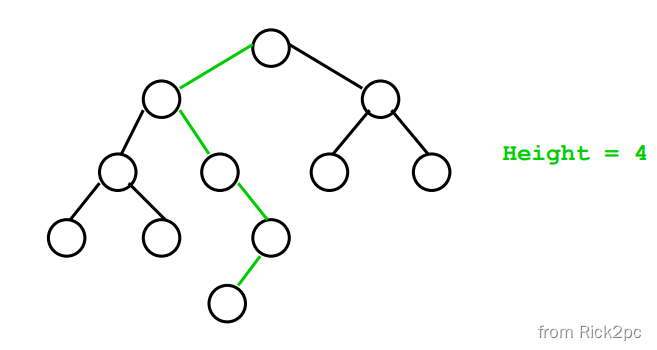
- Height (Depth) of a Binary Tree :The number of ==edges== on the ==longest== path from the root to a leaf.
2. Background: Complete Binary Trees
- A ==complete binary tree== is the tree.
- Where a node can have 0 (for the leaves) or 2 children.
- ==All leaves are at the same depth==.
- No. of nodes and height
- A complete binary tree with ==N nodes has height
==. - A complete binary tree with ==height d has
nodes==. 


- A complete binary tree with ==N nodes has height
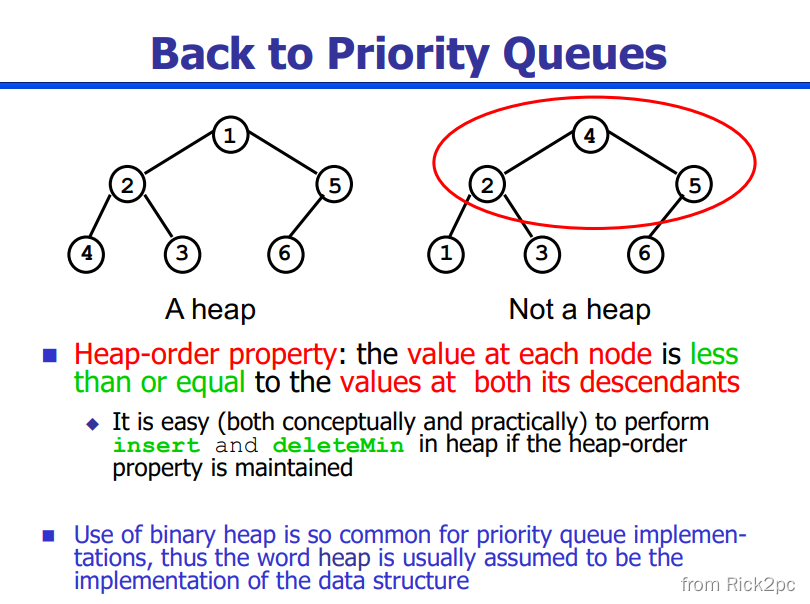
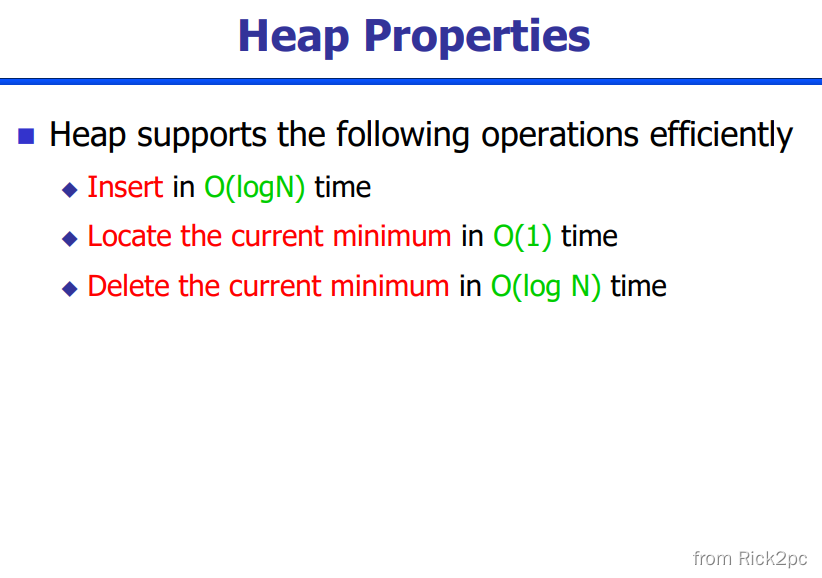
The property that allows operations to be performed quickly is the heap-order property. Since we want to be able to find the minimum quickly, it makes sense that the smallest element should be at the root. If we consider that any subtree should also be a heap, then any node should be smaller than all of its descendants. Applying this logic, we arrive at the heap-order property. In a heap, for every node X, the key in the parent of X is smaller than (or equal to) the key in X, with the exception of the root (which has no parent).2 In Figure 6.5 the tree on the left is a heap, but the tree on the right is not (the dashed line shows the violation of heap order). By the heap-order property, the minimum element can always be found at the root. Thus, we get the extra operation, findMin, in constant time.
3. Code
1 | //the children is smaller than the parent |
The answer of the lab
1 | **Maintain max-heap order*/ |
6. Trees
Preliminaries
- A ==tree== is a collection of nodes
- The collection can be empty;
- (Recursive Definition) If not empty, a tree consists of a distinguished node
(the ==root==), and ==zero or more== nonempty ==subtrees== , each of whose roots are connected by a directed ==edge== from r;
- ==Child== and ==Parent==
- Every node expect the root has one parent;
- A node can have an zero or more children
- ==Leaves==
- Leaves are nodes with no children
- ==Sibling==
- nodes with same parent
- ==Path==
- A path form
is defined as a sequence of nodes such that is the parent of for .
- A path form
- ==Length== of a path
- The length of this path(
to ) is the number of edges on the path, namely, . - There is a path of length zero from every node to itself;
- Notice that in a tree there is exactly one path from the root to each node.
- The length of this path(
- ==Depth of a node==
- The depth of
is the length of the unique path from the root to - The root depth is 0
- The depth of
- ==Height of a node==
- The height of
is the length of the longest path from to a leaf. - All leaves are at height 0;
- ==The height of a tree is equal to the height of the root.==
- The height of
- ==Ancestor== and ==Descendant==
- If there is a path from
to , then is an ancestor pf , and is a descendant of . If , then is a ==proper ancestor==(真祖先)of and is a ==proper descendant==(真后裔)of .
- If there is a path from
Tree Traversals with an Application
Example tree:

图4.14显示的是一个==表达式树(expression tree)==的例子。表达树的树叶(leaves)是操作数(operand), 如常数或变量名字,而其他的节点为操作符(operator)。由于这里所有的操作都是二元(二目)的,因此这棵特定的数正好是二叉树。我们可以通过递归计算左子树和右子树所得到的值应用在根处的运算符上而算出表达式树
1. Preorder Traversal(先序遍历)
==Expression order:
Prefix expression(前缀记法): $++abc+*defg$
Pseudo Code:
Time Complexity:
1 | void Tree::PreTraversal(TreeNode* root){ |
2. Postorder Traversal(后序遍历)
==Expression order:
Postfix expression(后缀记法):$abc+def+g*+$
Pseudo Code:
Time Complexity:
1 | void Tree::PostTraversal(TreeNode* root){ |
3. Inorder Traversal(中序遍历)
==Expression order:
Infix expression(中序记法): $a+bc+de+f*g$;
Pseudo Code:
Time Complexity:
1 | void Tree::InTraversal(TreeNode* root){ |
6.1 Binary Tree
A binary tree is a tree in which ==no node can have more than two children==.

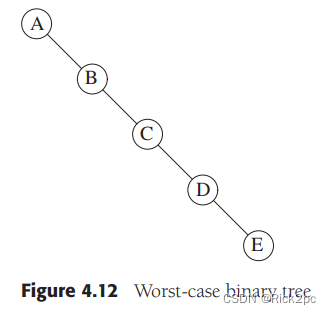
A property of a binary tree that is sometimes important is that the depth of an average binary tree is considerably smaller than N. An analysis shows that the average depth is
Binary Search Tree
Property: For every node

The ==average depth== of a (node)binary search tree turns out to be
Implementation of Binary Search Tree
1. Construct BST and the implementation of insertion
Construct: 利用insertion来构造BST。
Insertion:
Proceed down the tree as you would with a find;
If X is found, do nothing (or update something);
Otherwise, insert X at the last spot on the path traversed(将X插入到所遍历的路径的最后一点上)

1 | /*Insert node into BST, keeping the BST property. Use the "Insertion" method learned in slide.*/ |
The time complexity of insertion function is
Then the time complexity of constructing tree is
2. GetMinNode and GetMaxNode
Goal: Return the node containing the smallest(largest) key in the tree;
Algorithm: Start at the root and go left(right) as long as there is a left(right) child. The stopping point is the smallest (largest) element.
1 | TreeNode* Tree::getMinNode(TreeNode* root){ |
3. Treeheight
- Given a binary tree, find its maximum depth;
- The maximum depth is ==the number of nodes== along the longest path from the root node down to the farthest leaf node.(这里的定义和前面的有点不一样)
- A leaf is a node with no children.
1 | int Tree::TreeHight(TreeNode* root){ |
4. Height-Balanced
Determine if a BST is height-balanced. If balance return true, else return false.
- A height-balanced binary tree is defined as a binary tree in which the depth of the two subtrees of every node never differ by more than 1.
1 | bool Tree::IsBalanced(TreeNode* root){ |
5. Deletion
Deletion is more complex than the other implement, because we should consider how we take care of the children of the deleted node, we should consider following cases:
The node is a leaf, then we just delete it immediately;
The node has one child: Adjust a pointer form the parent to bypass that node;

The node has 2 children
- Replace the key of the node with the minimum element at the right subtree or the maximum element at the left subtree;
- Delete the minimum element
- Has either no child or only right child because if it has a left child, that left child would be smaller and would have been chosen. So invoke case 1 or 2.
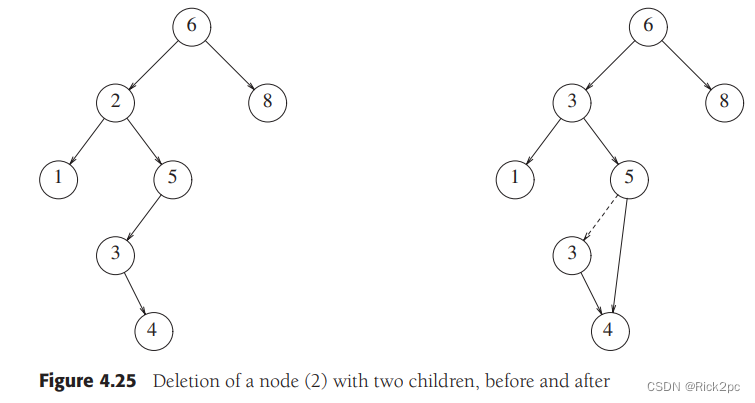
1 | /*Do a binary search. If input value "val" is found in BST, return true, else return false.*/ |
6.1.1 Balance Binary Search Tree

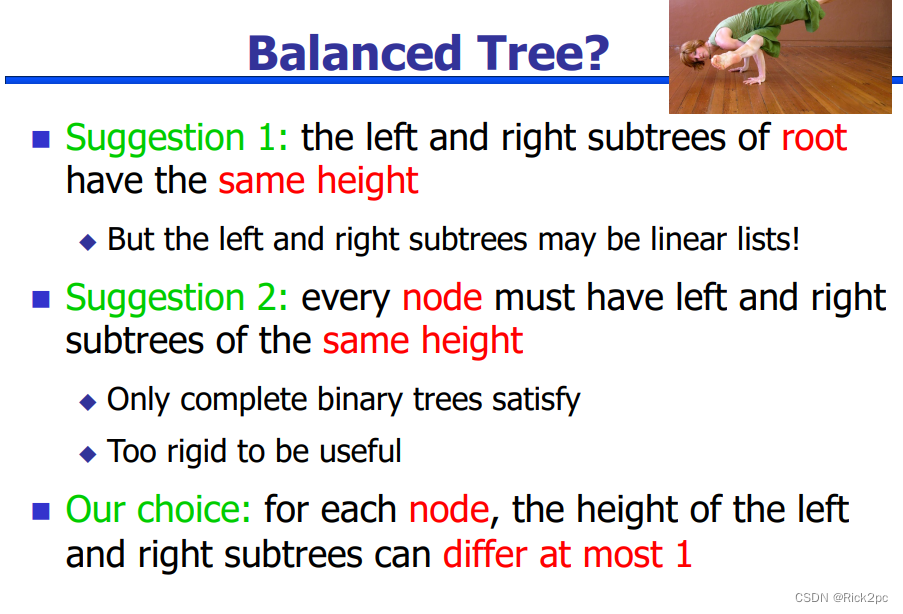
6.2 AVL Tree
An
An
- Height of subtree: Max # of edges to a leaf
- ==Height of an empty subtree: -1==;
- Height of one node: 0;

这两幅图中,只有左边的树为
- 除去可能的插入和删除外,所有的树操作都可以以时间
执行。
1. Height of
tree with minimum number of nodes - 在高度为
的 树中,最少点数 由 给出。
Denote
the ==minimum number of nodes== in an tree of ==height h==: - 在高度为
Base:
Recursive relation:

2. Insertion in
When we do an insertion, we need to update all the balancing information for the nodes on the path back to the root, but the reason that insertion is potentially difficult is that inserting a node could violate the
After an insertion, only nodes that are on the path from the insertion point to the root might have their balance altered because only those nodes have their subtrees altered. As we follow the path up to the root and update the balancing information, we may find a node whose new balance violates the
- Different Cases for Rebalance
- Denote the ==node== that must be rebalanced
: - Case 1: An insertion into the left subtree of the left child of
; (对 的左儿子的左子树进行一次插值) - Case 2: An insertion into the right subtree of the left child of
; (对 的左儿子的右子树进行一次插值) - Case 3: An insertion into the left subtree of the right child of
;(对 的右儿子的左子树进行一次插值) - Case 4: An insertion into the right subtree of the right child
;(对 的右儿子的右子树进行一次插值)
- Case 1: An insertion into the left subtree of the left child of
- Denote the ==node== that must be rebalanced
- 情形1(2)和4(3)是关于
点的镜像对称(mirror image symmetry)。 - So that there are actually two kinds of questions:
- Insertion occurs on the “outside” (i.e., left-left or right-right) is fixed by ==single rotation== of the tree;
- Insertion occurs on the “inside” (i.e., left-right or right-left) is fixed by ==double rotation== of the tree;
- Insertion Algorithm:
- Firstly, insert the new key as a new leaf just as in ordinary binary search tree;
- Then trace the path ==from the new leaf towards the root==. For each node x encountered, check if heights of left(x) and right(x) differ by at most 1.
- If yes, proceed to parent(x);
- If not, restructure by doing ==either a single rotation or a double rotation==.
- Note: once we perform a rotation at a node x, we won’t need to perform any rotation at any ancestor of x.
1. Single rotation
Case study: Right rotation
1 | TreeNode* AVLTree::rightRotate(TreeNode* curRoot) { |

It’s case 1, so we need to do right rotation to rebalance the
Here to fit the code, the “curRoot” is
And here let me show the process of the rotation:
- In the later code, some functions will call the rightRotate function to do the right rotation;
- The in the rightRotate function, we get the curRoot is
, we have to let the replace the location of ; - So what have to do is let the right subtree of
be , so that in the code; - And if there is an original right subtree of
we cannot forget it, we should change it to the left subtree of . - After that we return left the “Left” node to the location where it call;
- Here you may confused about what if
also has parents node? - Actually that’s the question what I have before. In fact, we return the node back where the function call, there is must a node to accept the return one, actually that node is “
”, we change the whole “ ” tree outside the whole tree, then we let the “ ” node change the value by (after rotation), then we finish the real replacement part. - 中文解释一遍:我们这一段代码你可以看做是从整一棵树里面抽出了那一棵有问题的子树进行修整,但是原本的树还是有问题,我们要将修整好的子树代替坏的子树,但是怎么换呢,我们知道root node相当于一棵树的identity,所以我们只要将修正好的树的root node传回给原本有问题的树的node那么就解决问题了,这里面就不用考虑说“
”的parent 怎么变换了,因为根本没有涉及。
- Actually that’s the question what I have before. In fact, we return the node back where the function call, there is must a node to accept the return one, actually that node is “
- Here you may confused about what if
- ==Time Complexity:
.==


2. Double rotation
Actually when we compile the code, we have not write another two functions of Double rotation. The process of implementation is call the single rotation function.


From that we can know that the double rotation have separate into two single rotations:
;
(Double Left rotation, firstly single left rotation then single right rotation)
. (Double right rotation, firstly single right rotation then single left rotation)


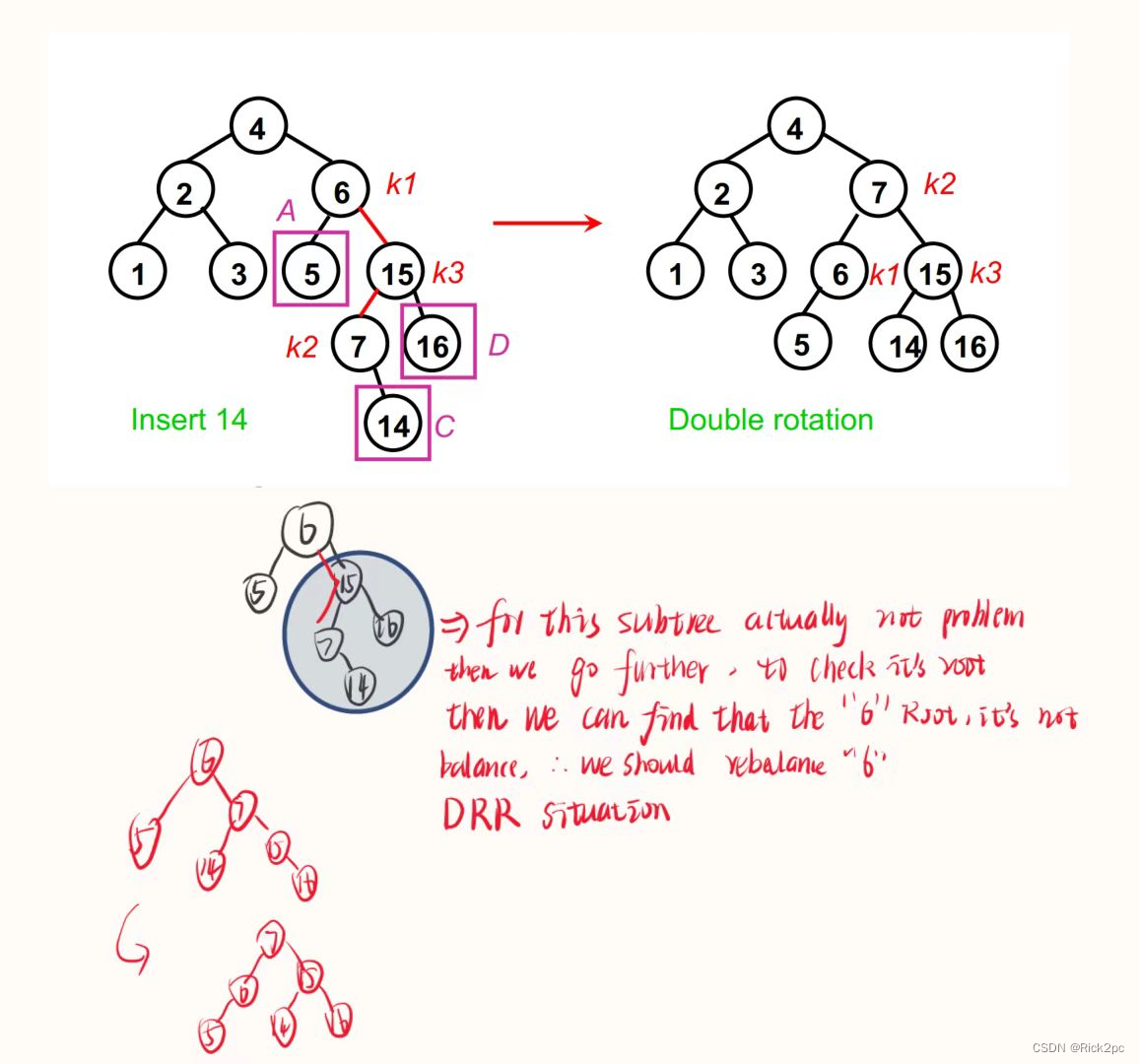
最重要的就是判断插入的元素所属的哪个父级出现了unbalance,然后看看是属于那种Case,然后使用相对应的rotation,解决😆😆😆
3. Insertion code
1 | TreeNode* AVLTree::rightRotate(TreeNode* curRoot) { |
Analysis
- Insert the new key as a new leaf just as in ordinary binary search tree:
; - The trace the path ==from the new leaf towards the root, for each node x== encountered:
; - Check height difference:
; - If satisfies
property, proceed to next node: ; - If not, perform a rotation:
;
- Check height difference:
- The insertion stops when:
- A rotation is performed;
- Or, we have checked all nodes in the path.
- Time complexity for insertion:
.
Here is a gif of insertion:

3. Deletion in
- Delete a node x as in ordinary binary search tree
- Note that the last (deepest) node in a tree deleted is a ==leaf== or ==a node with one child==
- Then trace the path from ==the new leaf towards the root==;
- For each node x encountered, check if heights of left(x), and right(x) differ by at most 1.
- If ==no==, perform an appropriate rotation at x;
- If ==yes==, proceed to parent(x);
- ==Continue to trace the path until we reach the root.==
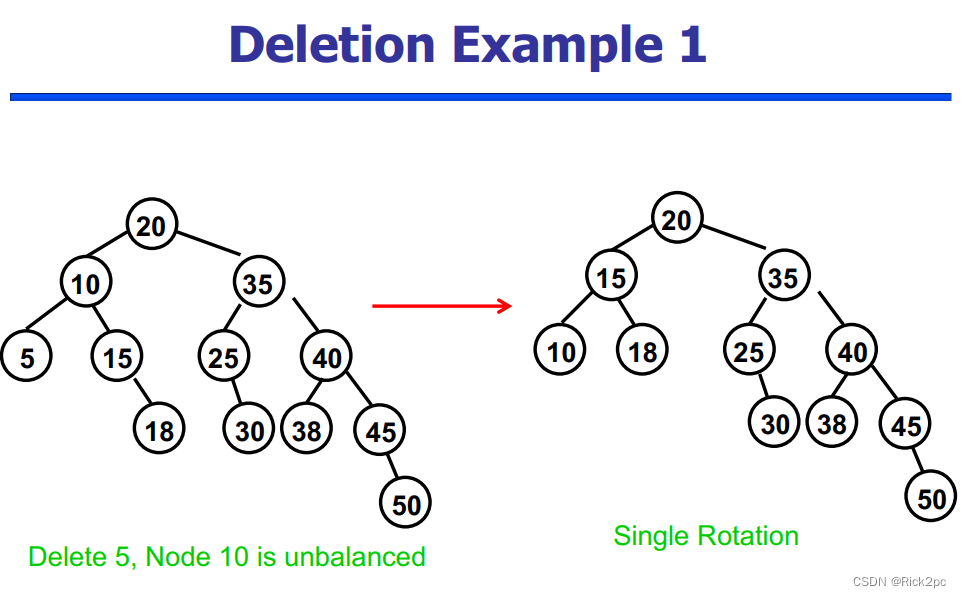


And here is a code in text book:
1 | void remove( const Comparable & x, AvlNode * & t ) |
4. Search function
1 | //Search the TreeNode WITHOUT recursive |
6.3 B+ Tree
在B+树中,我们不要求用代码实现出来,但是我们要知道它的实现过程是怎么样的。
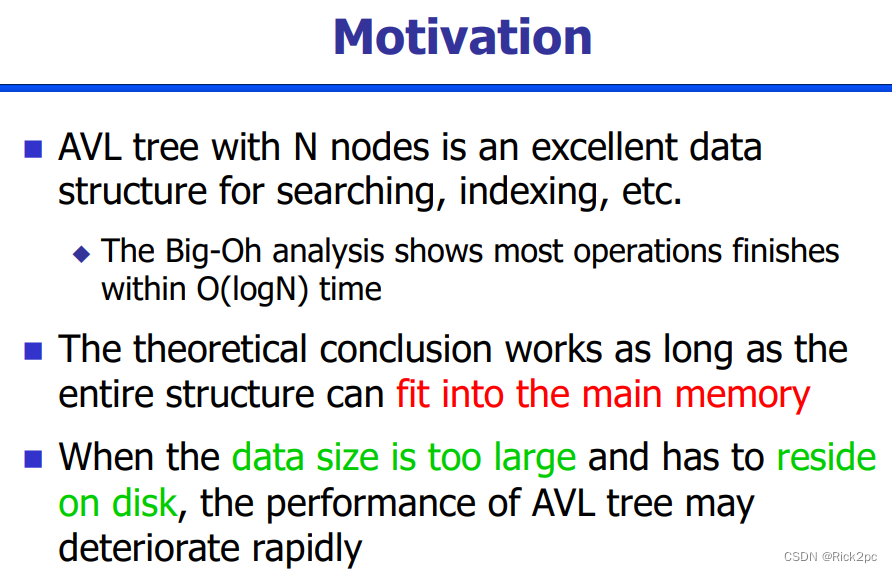


- M-ary Search Tree
- Binary search tree has one key to decide which of the two branches to take;
- M-ary search tree needs ==M-1 keys to decide which branch to take==;
- M-ary search tree ==should be balanced in some way too==;
- We don’t want an M-ary search tree to degenerate to a linked list, or even a binary search tree;
- Thus, require that each node is at least ½ full !
- 一棵
(M-ary search tree),可以有M路分支,随着分支增加,树的深度在减少。一棵完全二叉树的高度大约有 而一棵完全M叉树的高度大约为 .
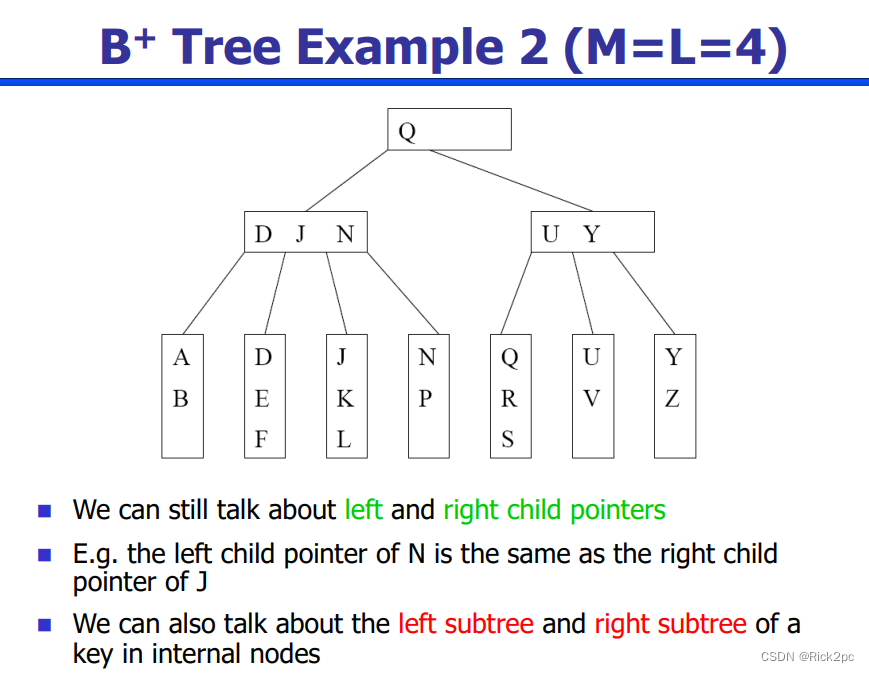
1. Property
A B+ tree of order
The data items are stored at leaves;(数据项存储在树叶上)
The nonleaf nodes store up to
keys to guide the searching; key represents the smallest key in subtree ;(非叶子节点存储到 个关键字以指示搜索的方向;关键字 代表子树 中的最小的关键字) The root is either a leaf or has between two and
children;(树的根或者是一片树叶,或者其儿子树在2和M之间) All nonleaf nodes (except the root) have between
and ==children==;(除根外,所有非叶子节点的==儿子数==在 and 之间) All leaves are at the same depth and have between
and ==data items==, for some (the determination of is described shortly).(所有的树叶都在相同的深度上,并且每片树叶拥有的数据项其个数在 and 之间) ==(
表示对x向上取整)== 注意,4,5点两个一个focus on子树的个数,另一个则是数据项(key)的个数

在这个B+树里面,第一行为root,第二行为nonleaf node/internal node,第三行为leaf node。
And:
- Records are stored at the leaves
- Since ==L===5, each leaf has between 3 and 5 ==data items==
- Since ==M===5, each nonleaf nodes has between 3 to 5 ==children==;
- Requiring nodes to be half full guarantees that the B+ tree does not degenerate into a simple binary tree.(要求节点为半满保证了B+树不会退化为简单的二叉树。)

2. Algorithm
1. Searching Algorithm
- Let x be the input search key;
- Start the searching at the root;
- If we encounter an internal node v, search (linear search or binary search) for x among the keys stored at v;
- If
at v, follow the left child pointer of ; - If
for two consecutive keys and at , follow the left child pointer of ; - If
at , follow the right child pointer of
- If
- If we encounter a leaf v, we search (linear search or binary search) for x among the keys stored at v. If found, we return the entire record; otherwise, report not found.
2. Insertion Algorithm
Supposed that we want to insert a key K and its associated record. First we should do is determine the location where it will be inserted. By search algorithm, which will bring us to a leaf x, then if the leaf is not full, we can directly insert the K, but what if it is already full?
Here is another crucial property of B+ tree: ==Splitting==, both insertion and deletion you will meet it.
Keeping going:
- If leaf x contains < L keys, then insert K into x (at the correct position in node x);
- If x is already full (i.e. containing L keys). Split x:
- Cut x off from its parent;
- Insert K into x, pretending x has space for K. Now x has L+1 keys.
- After inserting K, split x into 2 new leaves
, with containing the smallest keys, and containing the remaining keys. Let J be the minimum key in ; - Make a copy of
to be the parent of and , and insert the copy together with its child pointers into the old parent of ;
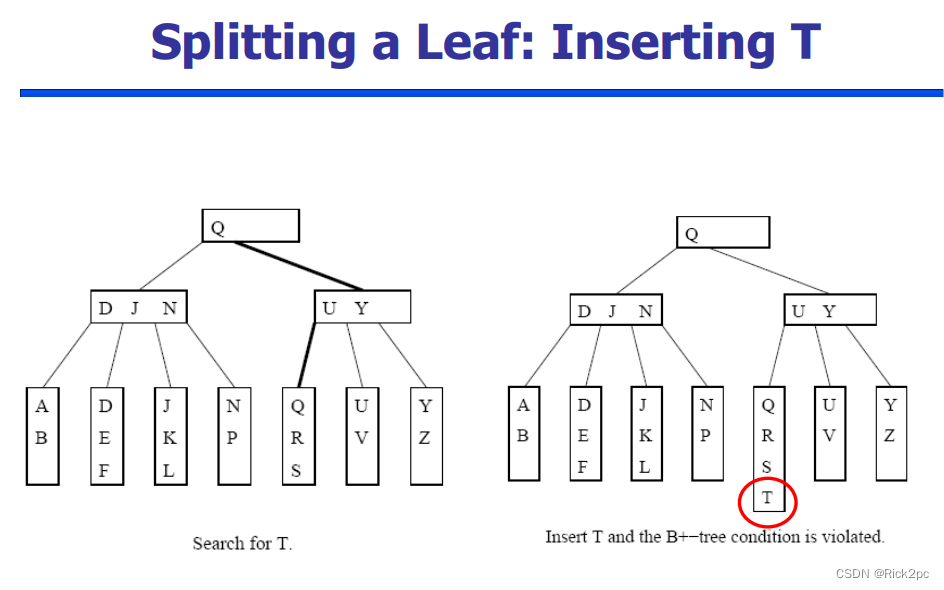


But here just the situation of leaf node split if we keep doing insertion, actually the internal node will finally full. Next I will show you how to split the internal node:
- Cut x off from its parent;
- Insert K and its left and right child pointers into x, pretending there is space. Now x has M keys;
- Split x into 2 new internal nodes
and , with containing the ( ) smallest keys, and containing the largest keys. Note that the ( )th key J is not placed in or ; - Make
the parent of and , and insert J together with its child pointers into the old parent of x.

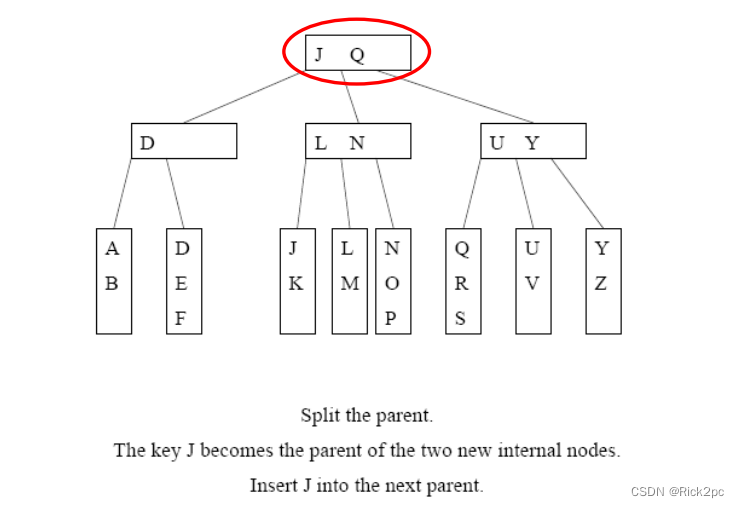

3. Deletion Algorithm
Same like the insertion, there are also two situations you have to take consideration.
- (1) target is a key in some internal node (needs to be replaced, according to our convention)
- (2) After deleting target from leaf x, x contains less than
keys (needs to merge nodes)
(这里面的target应该指的是internal node 里面的key值)
Target can appear in at most one ancestor y of x as a key, Node y is seen when we searched down the tree. After deleting from node x, we can access y directly and replace target by the new smallest key in x.
Suppose we delete the record with key target from a leaf. Let u be the leaf that has
Case 1: v contains
or more keys and v is the right sibling of u; - Move the leftmost record from v to u
Case 2: v contain
or more keys and v is the left sibling of u; - Move the rightmost record from v to u
Then set the key in parent of u that separates u and v to be the new smallest key in u;
(就是说,如果左叶子(右叶子)的key不满足前面我们提到的property的话,如果右叶子(左叶子)在满足property的下限还多的话,我们可以从中借一个或几个,或者直接merge掉两个叶子节点)
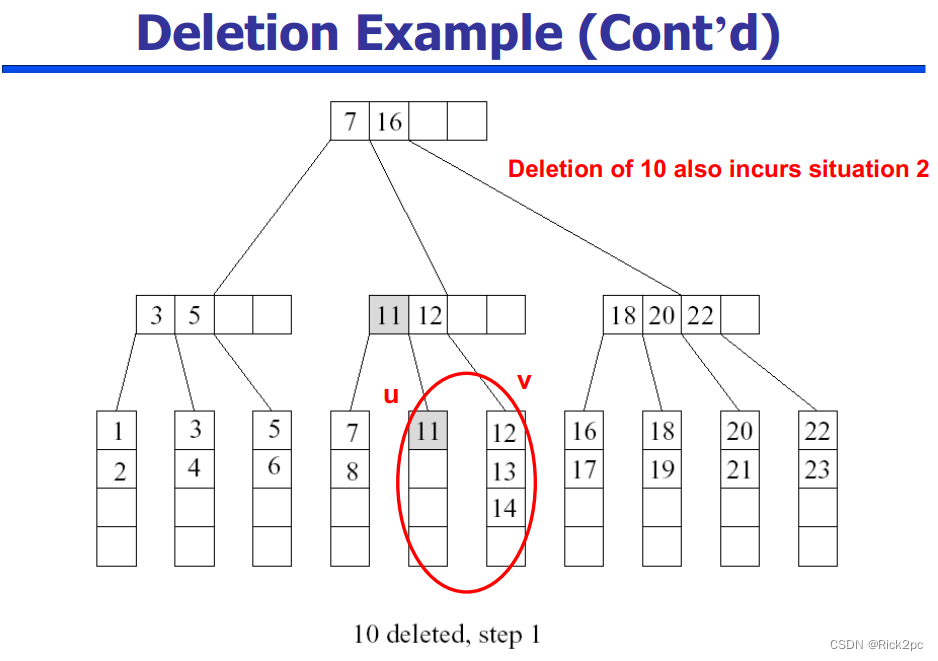
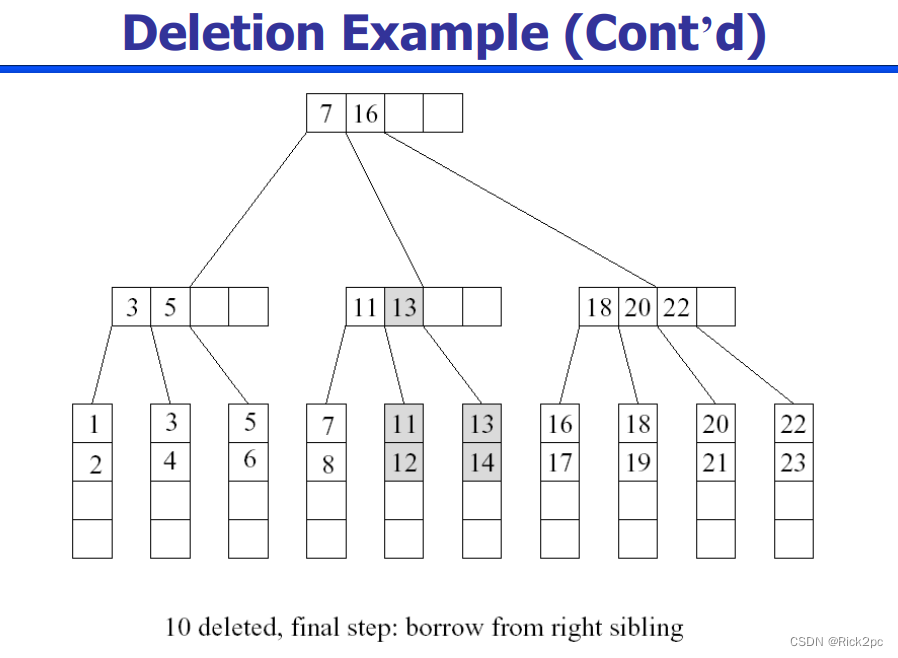
前面我们提到了merge,下面我们来讲讲merge的情况:
If no sibling leaaf with
Case 1: Suppose that the ==right sibling== v of u contains exactly
keys. Merge u and v: - Move the keys in u to v;
- Remove the pointer to u at parent;
- Delete the separating key between u and v from the parent of u.
Case 2: Suppose that the ==left sibling== v of u contains exactly
keys. Merge u and v : Move the keys in u to v;
Remove the pointer to u at parent;
Delete the separating key between u and v from the parent of u.

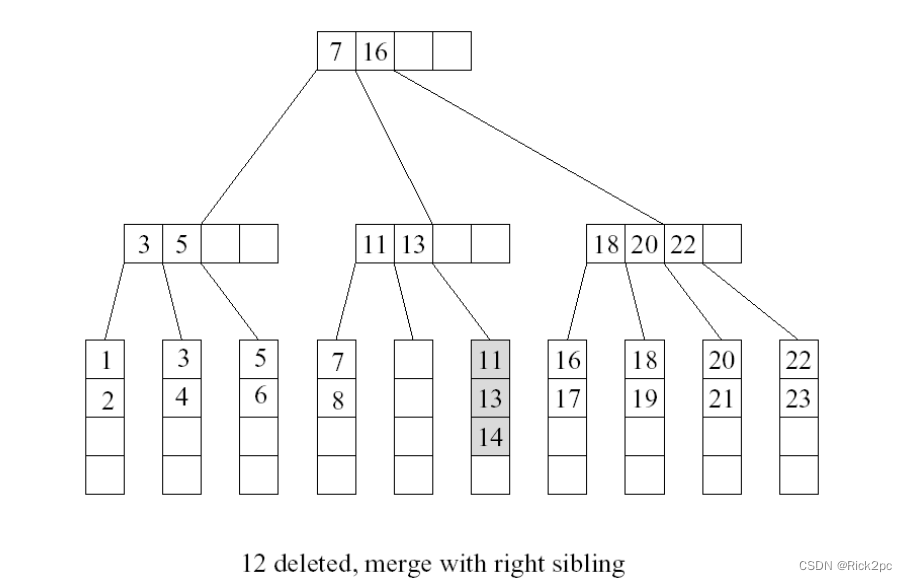
But if when we update the key value in the internal node:

Then the internal node doesn’t fit the property of B+ tree, so what should we do?
Deleting a key in an internal node:
Suppose we remove a key from an internal node u, and u has less than
- Case 1: u is a root
- Thus u has only one child, then we remove u and make its child the new root;
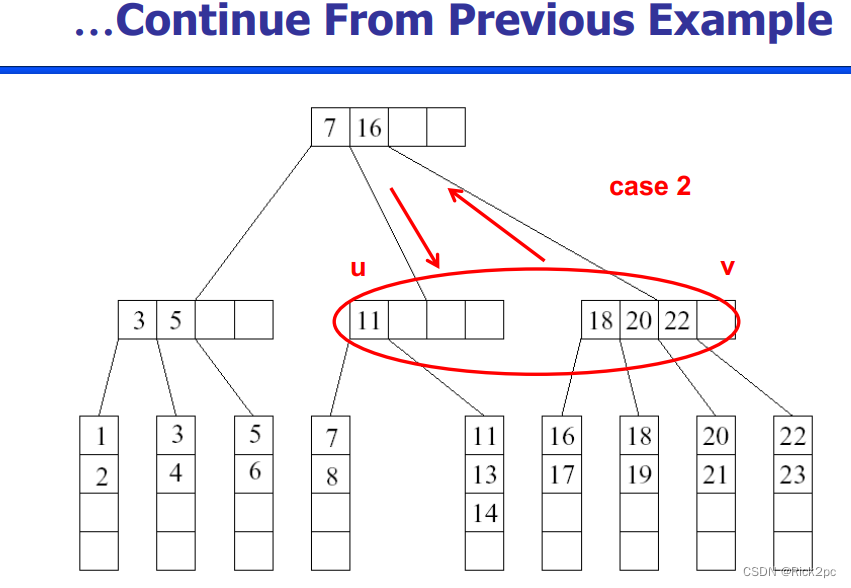
- Case 2A: the right sibling v of u has
keys or more: - Move the separating key between u and v in the parent of u and v down to u;
- Move the leftmost key in v to become the separating key between u and v in the parent of u and v;
- Make the leftmost child of v the rightmost child of u.
- Case 2B: the left sibling v of u has
keys or more: - Move the separating key between u and v in the parent of u and v down to u;
- Move the rightmost key in v to become the separating key between u and v in the parent of u and v;
- Make the rightmost child of v the leftmost child of u.
- Case study: Case 2A:

- Case 3: All sibling v of u contains exactly
keys: - Move the separating key between u and v in the parent of u and v down to v;
- Move the keys and child pointers in u to v;
- Remove the pointer to u at parent.


7. Graph
Consist of : vertex(节点),Edge(边)
Vertex can be considered “sites” or locations;
Edge represents connection.
Definition
- A graph G(V,E) consists a set of vertices, V, and a set of edges, E.
- Each edge is a pair of (v,w), where v, w belongs to V;
- If the pair is unordered, the graph is undirected(无向的); otherwise it is directed(有向的)
- Terminology:
- If
and are connected, they are said to be ==adjacent== vertices are endpoints of the edge { }.
- If an edge e is connected to v, then v is said to be incident on e. Also, the edge e is said to be incident on v;
- For undirected graph: {
}={ }; - For directed graph: they are not equal to each other.


- If
(我们无法在
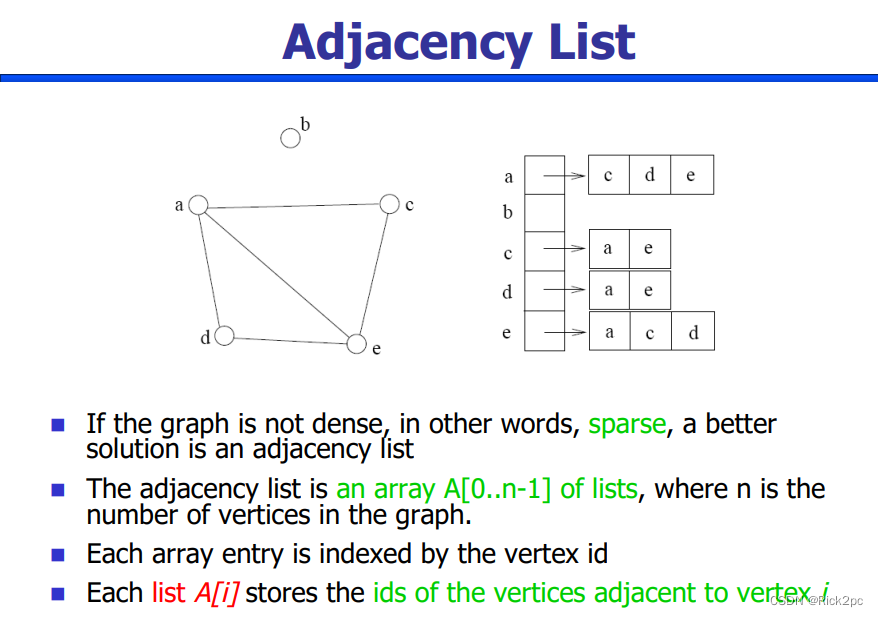
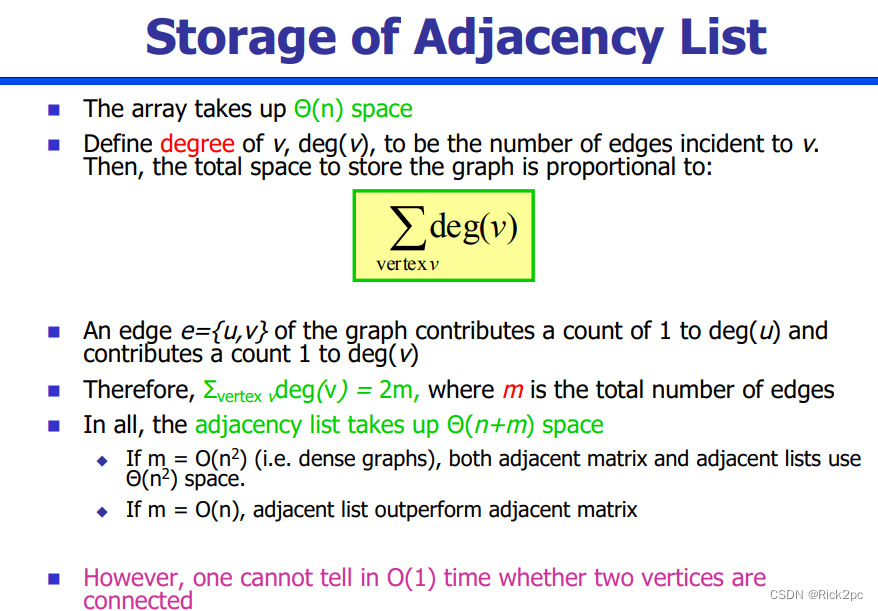
- Adjacency List:
- More compact than adjacency matrices if graph has few edges;
- Requires more time to find if an edge exists;
- Adjacency Matrix:
- Always require
space; - This can waste a lot of space if the graph is sparse(稀少的);
- Can quickly find if an edge exists.
- Always require

The code of adjacency list:
1 |
|
Graph Traversal
Example: Given a graph representation and a vertex s in the graph, find all paths from s to other vertices.
Two common graph traversal algorithms
- Breadth First Search (
) - Find all paths from s to other vertices;
- Depth First Search (
) - Topological sort;
- Find strongly connected components.
1.
1. Pseudocode
1 | Algorothm BFS |
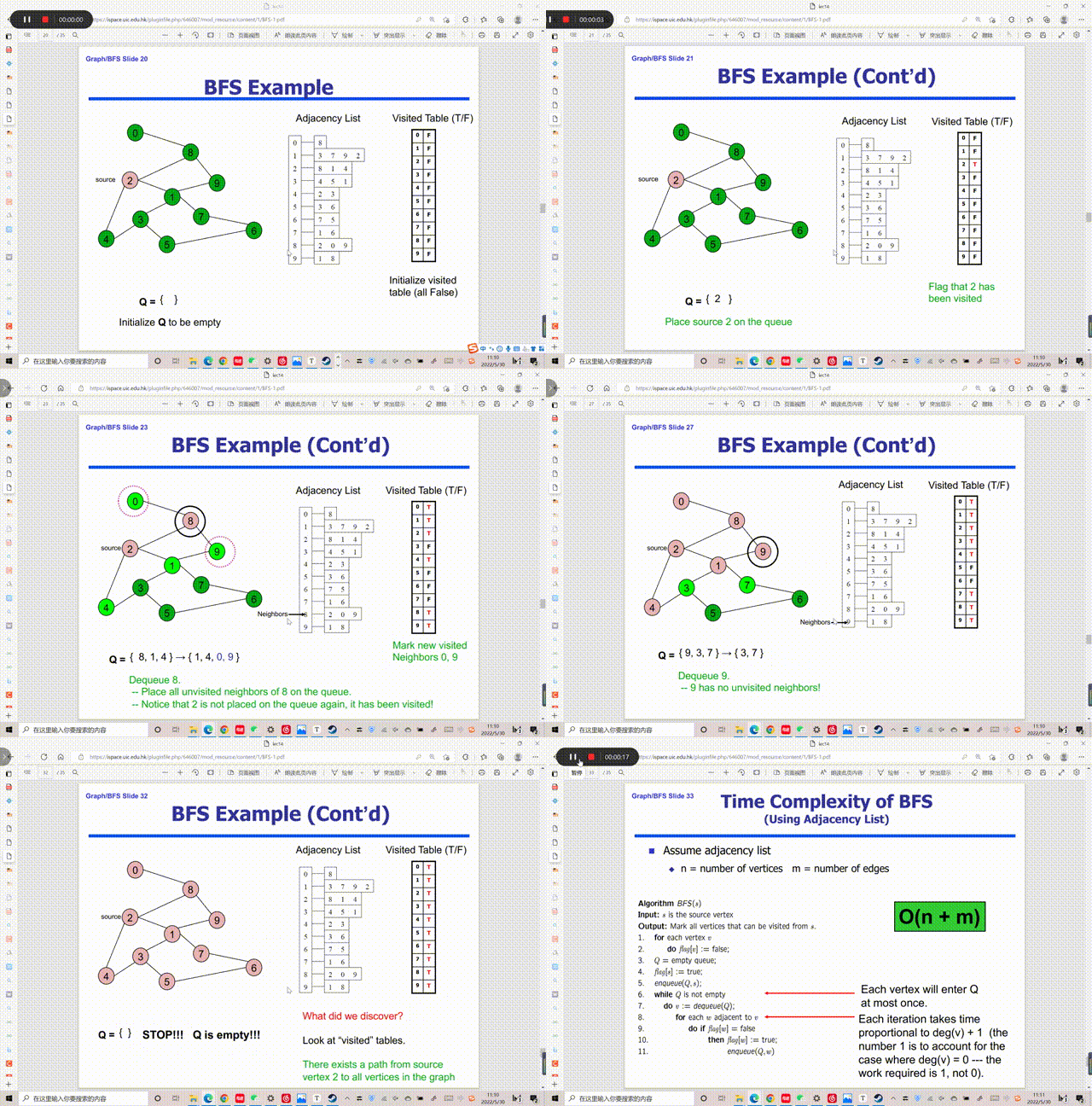
在上图中,source vertex为2,我们就先遍历它的所有adjacencies,我们看到下面的Q,就是为了方便我们标记哪一个已经被traverse过了,比如source vertex为2,我们就先把2 enqueue 到Q中,接着dequeue出来,并在visited table标记他已经被访问过了,然后把2的adjacencies enqueue到Q中,然后再重复操作。每一次dequeue一个vertex,就要把它的没有被标记过visited的adjacencies enqueue进Q中,直到所有的vertex都被标记为visited。
- Analysis:
- The line 6 of pseudocode: Each vertex will enter Q at most once;
- The line 8 of pseudocode: Each iteration takes time proportional to deg(v) + 1 (the number 1 is to account for the case where deg(v) = 0 —- the work required is 1, not 0).(在这里我是没看懂这个+1的解释的,我更倾向于把这个+1理解为代表dequeue)
- Then running time of adjacent list:
This is summing over all the iterations in the while loop - But for the adjacent matrix it will spend
.
So, with adjacency matrix,
2. Shortest Path Recording
1 | Algorothm BFS |

Path report:
1
2
3
4
5Algorithm Path(w)
1. if pred[w]!=-1
2. then
3. Parh(pred[w]);
4. uutput wThe path returned is the shortest from s to v(minimum number of edges).

Record the Shortest distance
1
2
3
4
5
6
7
8
9
10
11
12
13
14
15
16Algorothm BFS
Input: s is the source vertex
Output: Mark all vertices that can be visited from s.
1. for wach vertex v
2. do flag[v]:=false; //flag[]:visited table
3. pred[v]:=-1;d(v)=MAX_INT;//initializa all pred[v]to -1(this array is to help you record the previous vertex)
4. Q=empty queue;//use queue: FIFO
5. flag[s]:=true;d(s)=0;
6. enqueue(Q,s);
7. while Q is not empty
8. do v:=dequeue(Q);
9. for each w adjancent v
10. do if flag[w]=false
11. then flag[w]:=true;
12. d(w)=d(v)+1;pred[w]:=v;//record where you came from
13. enqueue(Q,w)Code of
: 1
2
3
4
5
6
7
8
9
10
11
12
13
14
15
16
17
18
19
20
21
22
23
24
25
26
27
28
29
30
31
32
33
34
35
36
37
38
39
40
41
42
43
44
45
46
47
48
49
50
51
52
53
54
55
56
57
58
59
60
61
62
63
64
65
66
67
68
69
70
71
72
73
74
75
76
77
78
79
80
81
82
83
84
85
86
87
88
89
90/* Graph Traversals: BFS (Breadth First Search) Queue */
using namespace std;
class Graph{
// Create pointer point to an array of list
list<int> *l;
int V;
public:
Graph(int size){
V = size;
l = new list<int> [V]; // [V] is the array contain V number of list
}
void addEdge(int i, int j, bool undir=true){
l[i].push_back(j);
if(undir){
l[j].push_back(i);
}
}
void printAdjList(){
// Iterate over all the rows
for(int i = 0; i < V; i++){
cout << i << "->";
// every element of ith linked list
for(auto node:l[i]){
cout << node << ",";
}
cout << endl;
}
}
void bfs(int source){
// Create queue
queue<int> q;
bool *visited = new bool [V]{0};
q.push(source);
visited[source] = true;
while(!q.empty()){
// Do some work for every node
int f = q.front();
cout << f << endl;
q.pop();
// Push the nbrs of current node inside q if they are not already visited
for(auto nbr : l[f]){
if(!visited[nbr]){
q.push(nbr);
visited[nbr] = true;
}
}
}
}
};
int main(){
Graph g(9);
g.addEdge(1 - 1, 2 - 1);
g.addEdge(1 - 1, 9 - 1);
g.addEdge(2 - 1, 1 - 1);
g.addEdge(3 - 1, 4 - 1);
g.addEdge(3 - 1, 5 - 1);
g.addEdge(3 - 1, 6 - 1);
g.addEdge(3 - 1, 9 - 1);
g.addEdge(4 - 1, 3 - 1);
g.addEdge(5 - 1, 3 - 1);
g.addEdge(5 - 1, 8 - 1);
g.addEdge(6 - 1, 3 - 1);
g.addEdge(6 - 1, 7 - 1);
g.addEdge(7 - 1, 6 - 1);
g.addEdge(7 - 1, 9 - 1);
g.addEdge(7 - 1, 8 - 1);
g.addEdge(8 - 1, 5 - 1);
g.addEdge(8 - 1, 7 - 1);
g.addEdge(9 - 1, 1 - 1);
g.addEdge(9 - 1, 3 - 1);
g.addEdge(9 - 1, 7 - 1);
g.bfs(0);
g.printAdjList();
return 0;
}
2.
is another popular graph search strategy; - Idea is similar to pre-order traversal (visit node, then visit children recursively);
can provide certain information about the graph that cannot; - It can tell whether we have encountered a cycle or not.
- 深度优先算法是对先序遍历(preorder traversal)的推广。
will continue to visit neighbors in a recursive pattern: - Whenever we visit v from u, we recursively visit all unvisited neighbors of v. Then we backtrack (return) to u.
- 这里面一开始的递归访问v的所有unvisited neighbors并不像
那样先把v的所有neighbors都加入到queue里面,而是另外的意思,稍后会解释。
1 | Algorithm DFS(s) |

这么理解递归的意思:从source开始,一条路走到黑,然后返回到上一个,如果上一个的neighbors也都标记了,继续return,如果return到没有被标记的,那就走那条路然后一条路走到黑。如果都被标记了,那就return回source vertex。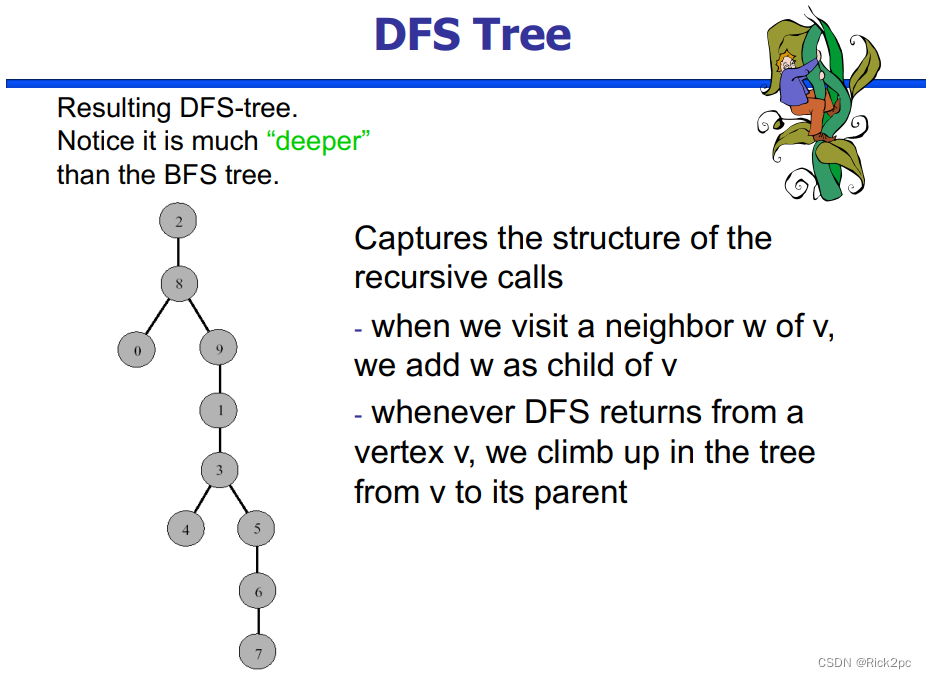

1 | /* Graph Traversals: DFS (Depth First Search) Stack */ |
在这里多讲一嘴:for(auto a:b)
- 这里面可以简单将b看做一个array,但是其实适用于各种容器;
- a的话相当于一个接收变量来接收b中的值,每一次迭代,a都代表了b中的一个变量
- 比如说:for(auto a:b=[1,2,3,4]){cout<<a;}那么每一次循环中a的值分别为:1,2,3,4
8. Reference
Data Structures and Algorithm Analysis in C++
The lecture slides
Information from Internet